

Key Takeaways
- A good IT partner meets with you regularly to provide thorough quarterly updates, not just when something breaks.
- Trust matters more than technical knowledge. If you can’t have an honest conversation with your IT provider, the relationship will not hold up when things go wrong.
- Proactive providers solve problems before you ever know they exist.
- Your IT needs will change as your business scales. The right provider understands both your business and your systems and grows with you.
- Quarterly business reviews with both a technical contact and a relationship-level lead are the standard to expect.
If something were to go wrong with your technology tomorrow, do you fully trust the people managing it? Can you rely on them to not only fix the problem, but to tell you the truth about what happened in language you understand and help ensure it doesn’t happen again?
When choosing the right managed IT provider for your business, it’s important not to just focus on certifications, though those are important. A good relationship is built on trust, proactivity, and whether your IT partner genuinely understands your business in addition to your environment.
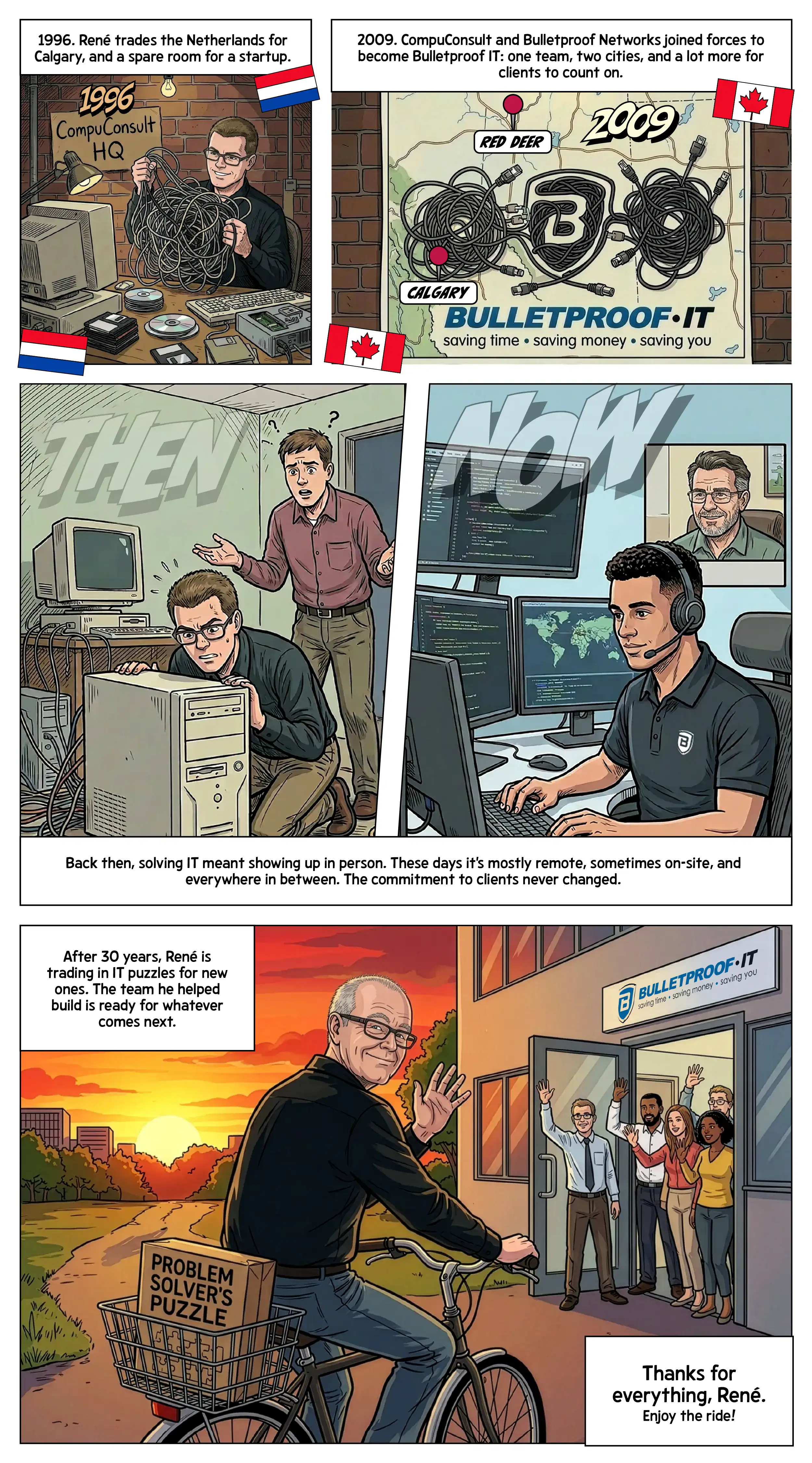
Bulletproof IT co-founder René Sloos is retiring after 30 years of working with small- and medium-sized businesses across Alberta. In honour of that occasion, this article captures what three decades in this industry taught him about what makes IT partnerships work, so you can apply it to your own organization.
What has changed in IT support over 30 years, and what hasn’t?
When René started in this industry, computers weren’t yet connected to the internet. If something broke, someone had to physically drive out. A significant portion of the job involved opening machines and manually configuring hardware settings that don’t even exist anymore.
Today, most support is handled remotely
While the tools, delivery, and problems are different from before, one thing that hasn’t changed is the need for someone who is dependable, solves problems, and keeps things running. What has changed significantly is the scope of that work. Early on, the job was largely about keeping machines running and connecting them to each other. Today it also includes protecting those connections, managing cloud environments, and helping businesses navigate a threat landscape that didn’t exist when René started. The fundamentals are the same. The surface area is much larger.
The constant underneath all that change
Another thing has stayed constant throughout the years: after 30 years of working across different industries, René has found that about 80% of the technology businesses use is the same. It’s the remaining 20% where having someone who is genuinely curious about your business becomes essential.
It looks different for every client. A dental office runs practice management software with specific compliance requirements. An oil and gas firm has field tools and regulatory reporting that have nothing to do with a nonprofit’s donor database or a millwork company’s production tracking. Providers that genuinely take the time to understand how each of those businesses operates will ask better questions, catch problems others miss, and give advice that fits your situation rather than a generic one.
René summed up what working across that many industries actually feels like: “always drinking from the fire hose.” A provider who stops learning stops being useful.
That accumulated cross-industry exposure is part of what brought Rene’s former company, CompuConsult together with Bulletproof Networks, when they merged in 2009 to form Bulletproof InfoTech.
What does a good IT partnership actually look like for a small business?
René sometimes asked his own staff: are we in the technology business or the people business? His answer was always the people business. Technology is what they do, but trust is what makes it work.
A good IT partner doesn’t just keep your systems running. They’re also interested in learning how your business works. René described what that looks like from the inside: getting to “look into the kitchen of what all these other companies do.” Whether it’s understanding what a millwork company is involved in or how a nonprofit serves its community, that curiosity is what separates a provider who fixes your computers from one who helps your business run better.
Here’s what that should look like in practice:
- They ask questions about your business, not just your technology. If they don’t understand what you do, they can’t give advice that fits.
- They think ahead. If you’re planning to hire ten people, they should already be considering what that means for your network, your licensing, and your security posture.
- They show up before something breaks. At a minimum, expect quarterly reviews that cover what happened, what’s coming, and how your IT aligns with where your business is headed. Those reviews should be a business conversation, not just a technical one.
If your IT provider only shows up when something is broken, that’s a repair service, not a partnership.
Why does trust matter more than technical knowledge?
Most business owners aren’t IT experts, and they don’t have to be. It’s the provider’s job to understand the technology. Clients need to be able to trust that the provider is communicating honestly and proactively about the issues, costs, and risks.
René put it plainly: “It’s similar to going to a car repair guy. The car repair guy can tell me anything. I don’t know anything about engines, nor do I want to know anything about engines. I want somebody I can talk to that I trust.”
Every IT provider you’re considering can presumably fix your computers. That should be the baseline. The question is whether you trust them to tell you what they actually found, explain what they recommend and why, and have an honest conversation when something goes wrong on their watch.
When issues inevitably arise, the relationship determines the outcome. A provider who has invested in a real relationship with you will handle that conversation differently than one who has been mostly transactional. Trust is built through proactive communication, transparency, and showing up for hard conversations. It can’t be manufactured in a crisis.
How do you tell the difference between a reactive IT provider and a proactive one?
A reactive provider fixes things after they break. A proactive one resolves problems before the client is even aware there was one.
COVID-19 is a good example. When businesses had to shift to remote work almost overnight, the experience varied dramatically depending on how prepared their IT infrastructure was. Bulletproof IT clients were already set up for remote access, so the transition was fast and relatively smooth. René called it being in a “lucky position,” but it wasn’t luck. It was preparation that had been put in place well before anyone knew it would be needed.
That same principle applies to the relationship itself. René made the point that bad news travels up the chain fast, while good news rarely does. When something goes wrong, leadership hears about it immediately. That’s why the relationship between a client and their IT provider has to be strong enough to absorb those moments, not just the smooth ones. A provider who only communicates when there’s a problem isn’t proactive. They’re just occasionally visible.
Proactive IT providers are already thinking about your resilience before you raise it. Ask a prospective provider what problems they’ve solved for clients before those clients knew there was an issue. If they can’t give you a clear answer, that tells you something.
What should you expect from your IT provider as your business grows?
Most businesses don’t think about outgrowing their IT provider until they already have, and by then, the gaps are showing. A good IT partner grows with you rather than forcing you to start over.
René understands this firsthand. His first business, CompuConsult, was a basement operation with a team of four or five. At around a million dollars in annual revenue, he knew growing further would require more structure than he could provide alone. That led to peer groups, formal business education, and eventually the merger that became Bulletproof IT.
The lesson is that scaling a business exposes gaps in processes, capabilities, and how you’re organized. A provider who has been through that kind of growth themselves understands what it looks like from the inside and can help you see it coming before it becomes a problem.
Part of what makes a team effective over the long term is complementary strengths. René was candid about this. His strength was relationships and staying calm when things went sideways. “Walking into a fire,” as he put it. The more precise, methodical work belonged to others on the team. A good IT provider isn’t one person who does everything well. It’s a team where different strengths cover each other, so that whatever your business runs into, someone is equipped to handle it.
Frequently Asked Questions
How often should my IT provider check in with me and what should those conversations look like?
A provider who only contacts you when something breaks isn’t meeting the standard. Ideally, you should be at least having formal quarterly reviews where you can receive a summary of support activity and recurring issues, the status of any open projects, a review of your security posture, a look ahead at planned changes, and an honest conversation about whether the relationship is working.
What is the difference between break-fix IT support and managed IT?
Break-fix is reactive: you call when something stops working and pay per incident. Managed IT is an ongoing relationship where the provider monitors your systems continuously and charges a flat monthly fee. Because they’re not billing by the hour, a managed provider is financially aligned with keeping your systems healthy, not waiting for them to fail.
How do I know if my IT provider is keeping up with changes in technology?
Ask them directly. A good provider can tell you what has changed in their practice over the past year and what threats or tools they’re currently tracking. If they only bring things up after you ask, that’s worth noting.
What are the warning signs that it’s time to switch IT providers?
Problems keep recurring, no one is flagging risks before they become issues, and your provider only shows up when something breaks. Other signs include no regular business reviews, generic advice that doesn’t reflect how your business actually works, and a provider who goes quiet when something goes wrong on their watch.
Consider What Your IT Partnership Could Look Like
The main ingredients of a strong IT partnership are trust, proactivity, and a provider who understands your business, not just your systems. The wrong partner can cost you more than money. It costs time spent managing a relationship that should be managing itself.
René said he hoped that when he leaves, Bulletproof IT would be a company people look at and say: “That’s a good company. That’s a company I trust. That’s a company that helps out in our community.” During COVID, that looked like the team scraping together old computers, cleaning them up, and getting them into the hands of families who suddenly had three or four kids needing to work and study from home.
After 30 years, what René says he’ll miss most isn’t the technology. It’s the people. That’s probably the best thing you can say about anyone who spent three decades in this business, and it’s the standard we hold ourselves to every day at Bulletproof IT. If you’re not sure whether your current IT partner is meeting this standard, let’s chat.
If you want to go deeper on what proactive IT protection looks like in practice, a good next read is Why Traditional Cybersecurity Measures Miss Identity Threats. It covers exactly the kind of risk a proactive IT partner should already be thinking about on your behalf.